11min read
Content
,
Business Podcasting
A few years ago, a business podcast was usually a side project, run by whoever on the team was keenest, recorded on borrowed gear, and quietly abandoned after a dozen episodes. In 2026, something has changed. Across Melbourne and Sydney, podcasts have moved out of the marketing experiments folder and into considered, funded, long term channels, backed by businesses that treat them as seriously as any other part of how they build trust and win work. This article looks at why that shift has happened, and, just as importantly, what it actually takes to do it well, because the businesses succeeding with podcasts in 2026 are the ones who understood both.
THE PROBLEM EVERY BUSINESS IS QUIETLY TRYING TO SOLVE
Modern marketing has an attention problem, and everyone in it knows it. Advertising is easier to ignore than ever. Inboxes are crowded, feeds are endless, and audiences have become expert at scrolling past anything that looks like it wants something from them. Meanwhile the thing that actually moves people, trust, has become harder and slower to earn. Businesses can buy reach, but they cannot buy belief, and belief is what turns attention into work won.
This is the gap a podcast fills better than almost anything else a business can make. It does not interrupt people. It invites them. Someone chooses to spend thirty or sixty minutes with a business's thinking, its people, and its point of view, and that chosen, sustained attention builds a kind of trust that a fifteen second ad cannot approach. For a business trying to be believed rather than merely seen, that is the whole game.
WHY LONG FORM WORKS WHEN EVERYTHING ELSE IS GETTING SHORTER
It seems backward. In an era of shrinking attention spans and vertical clips, why would long form conversation be gaining ground with serious businesses. The answer is that the two work together rather than against each other. The long conversation is where trust and authority are built, slowly and properly, with room to explain, to disagree, to show real expertise rather than assert it. The short clip is how people discover that the conversation exists. One earns belief. The other earns attention. A business that produces both has a system, not a series of posts.
Long form also does something short content structurally cannot. It lets a business demonstrate depth. Anyone can claim expertise in a caption. Sitting for an hour and actually being expert, thinking clearly, handling a hard question, showing how you reason, proves it in a way no advertisement ever will. For businesses whose entire value rests on being trusted with something important, that proof is worth more than reach.
THE B2B CASE IS STRONGER THAN THE B2C ONE
It is tempting to think podcasts suit consumer brands with big audiences. In practice, the case is often stronger for businesses selling to other businesses, and that is much of what is driving the shift in Melbourne and Sydney's professional markets. B2B decisions are slow, relationship led, and built on trust between a small number of people who need to be confident before they commit. A podcast is unusually good at exactly that.
It lets a business build a relationship with a prospect long before any sales conversation, so that by the time they speak, the trust already exists. It gives a reason to reach out to the exact people a business wants as clients, by inviting them on as guests, a conversation almost no one refuses and that builds a relationship no cold email could. It becomes sales enablement, content a team can send to a prospect that does more to build confidence than any brochure. And it doubles as recruitment, showing prospective hires what a business actually thinks and how its people actually are. For a professional services firm, a consultancy, or any business where trust is the product, a podcast is one of the few channels that works on all of those fronts at once.
THE CONTENT ENGINE, NOT THE CONTENT PIECE
The businesses getting the most from podcasts in 2026 have stopped thinking of a show as a series of episodes and started thinking of it as an engine. One properly produced session, filmed and recorded well, becomes a full episode for YouTube and podcast apps, several short clips for social platforms, quotes and stills for newsletters and posts, and imagery that supports the wider brand. A single afternoon in a studio can feed weeks of content across every channel a business uses.
This is the practical reason podcast budgets have moved from experimental to considered. A business is not funding a hobby. It is funding a content operation that produces across formats from a single, planned input, which is a far more efficient way to stay visible than producing each piece separately. Understood that way, the cost looks less like an expense and more like infrastructure.
WHY MELBOURNE AND SYDNEY, AND WHY NOW
The two cities that anchor Australia's business world are where this shift is most visible, and the reasons are practical. Both have dense concentrations of the professional services, technology, and founder led businesses for whom trust and authority are the deciding factors in winning work. Both have the client base, the guest pool, and the ambition that a serious show needs. And both now have studios built to a standard that makes producing this content properly possible without a business building a production team of its own.
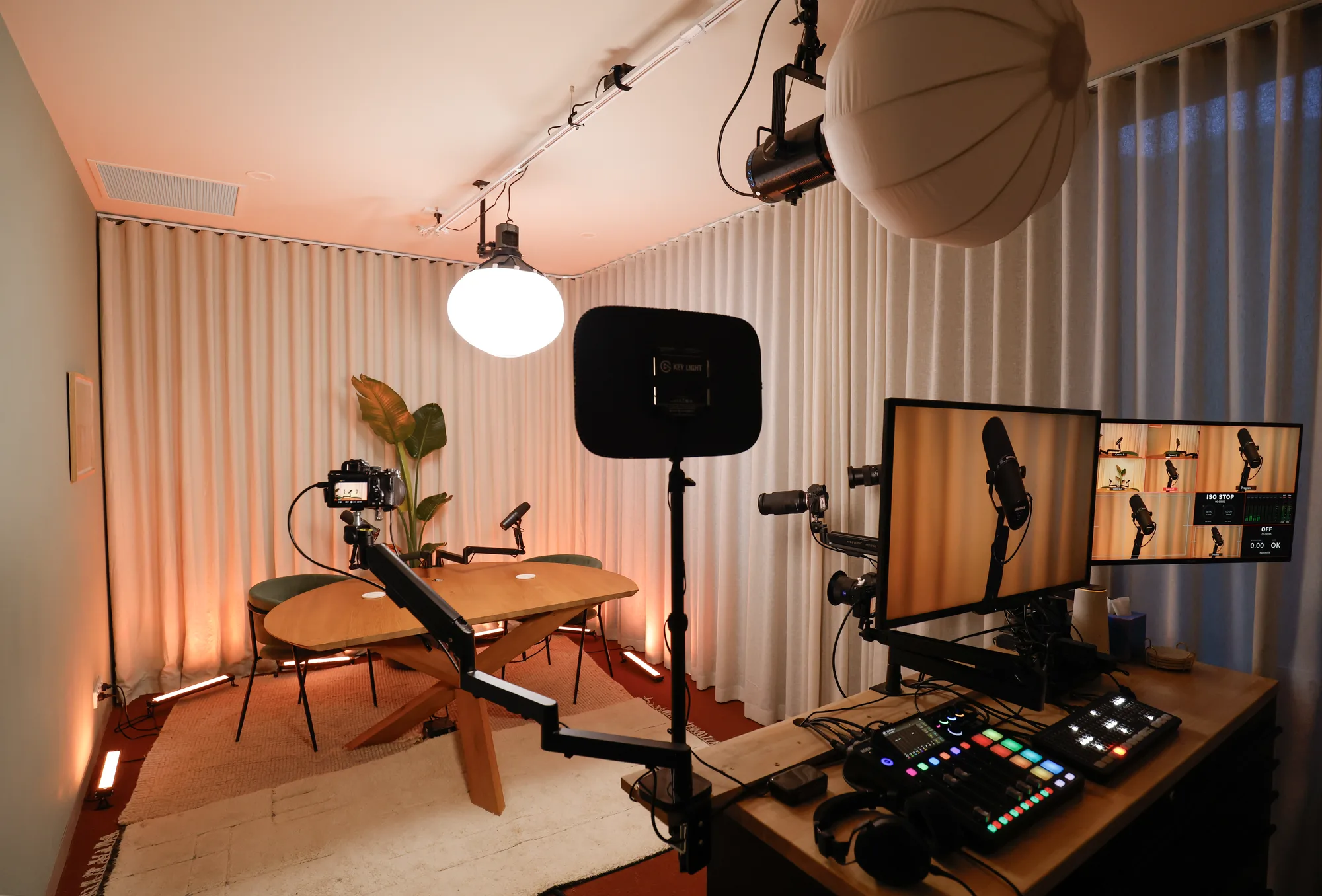
That last point matters more than it seems. The reason podcasts used to be side projects is that doing them well was genuinely hard and expensive to do in house. The rise of studios that handle the entire production, from the room and the cameras to the direction and the finished delivery, has removed that barrier. A business can now back a podcast the way it backs any other professional channel, by partnering with people who do it for a living, rather than asking its own team to become broadcasters.
THE HONEST PART: WHAT IT ACTUALLY TAKES
None of this works as a casual effort, and the businesses that treat it casually are the ones who quietly give up. A podcast that earns trust and drives growth requires three things a business has to be honest with itself about before starting.
The first is consistency. A show that appears and disappears builds nothing. Trust is earned through showing up on a rhythm the audience can rely on, whether weekly or fortnightly, sustained across a season and beyond. That is a commitment, not a burst of enthusiasm.
The second is a quality bar that reflects the brand. In 2026, audiences read production quality instantly and judge the business by it. A show that looks and sounds considered lifts a brand. One that looks improvised diminishes it. There is no neutral option. This is why the production standard is not a detail but a decision, and why doing it badly is often worse than not doing it at all.
The third is patience measured against the right outcomes. A podcast is not a performance marketing channel with a next day return. Its value shows up as trust, relationships, authority, and pipeline, over months, not clicks over days. Businesses that judge it by vanity metrics in week two abandon it before it has done the thing it is actually good at.
WHAT SUCCESS ACTUALLY LOOKS LIKE
Because the outcomes are slower and deeper than a typical campaign, it is worth being clear about what winning looks like, so a business measures the right things. Success is a prospect arriving at a sales conversation already trusting the business because they have listened for months. It is a guest becoming a client, or an introduction, because the conversation built a relationship. It is a team sending an episode to a lead and shortening a sales cycle. It is a strong hire who chose the business partly because the show told them who they would be working with. These are not the metrics a dashboard shows by default, but they are the returns a business podcast is built to produce, and they compound.
BACKING ONE SENSIBLY
For a business persuaded by the case but wary of overcommitting, the sensible path is not to build a flagship production before there is any proof the format works. It is to commit properly to a first season, typically eight to twelve episodes, produced to a standard that flatters the brand, and then to decide what comes next based on real audience and real business outcomes rather than a guess. That approach gives a show a fair chance to work while keeping the initial commitment measured. Our guide to podcast production costs in Australia lays out what a first season at that standard actually costs, so the budget conversation starts from a real number.
The businesses backing podcasts in 2026 are not chasing a trend. They are responding to a real and lasting change in how trust is built, and choosing a channel unusually good at building it. The ones who will look back on the decision as a good one are those who committed properly, produced well, and measured it against the outcomes that matter.
If your business is weighing whether a podcast is worth backing, the best place to start is a conversation. Come and see one of our studios, and we will talk honestly about whether a show is right for you, and what it would take to make one worth watching.
— On The Record
"Every brand says it wants trust. A podcast is you earning it out loud, on the record, one honest conversation at a time. The businesses brave enough to keep showing up are the ones people remember."
· Continue reading
More from the desk



New articles, fortnightly.
Production insights and studio craft, direct to your inbox. Straight from the studio.